
Honoring the Best of Consulting Engineering since 1989.

2026 Award of Merit
Owner: Ministry of Environment and Parks (BC Parks) | Hope, BC
About the Project
The replacement of BC Parks Bridge 1 at Coquihalla Canyon Park required an innovative response to an exceptional combination of constraints: a narrow canyon, limited access, active rockfall hazards, strict environmental controls, and the need to preserve a nationally significant heritage corridor. Innovation was embedded not in a single feature, but in the integrated engineering strategy developed to deliver a durable, constructible, context-sensitive solution.
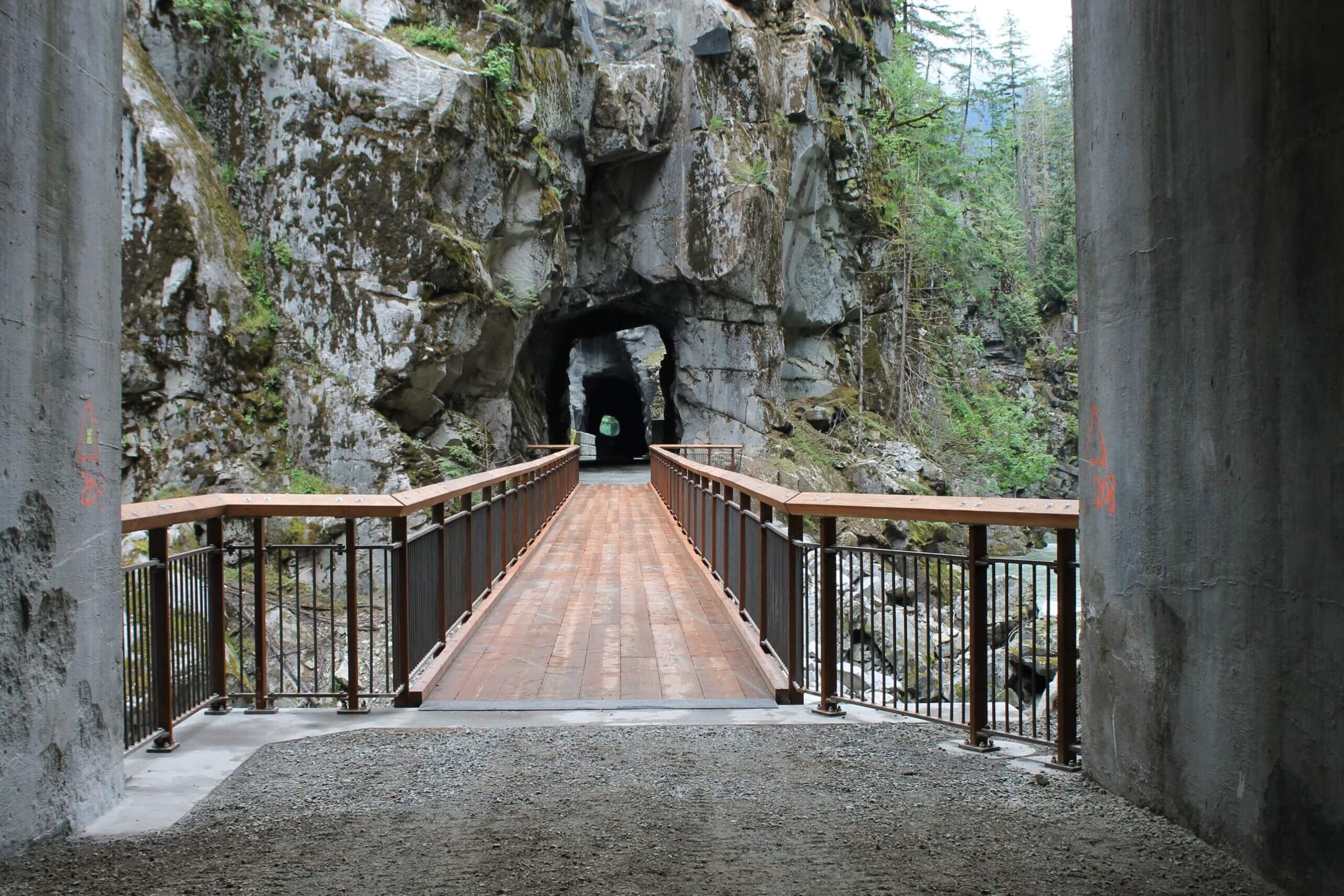
Coquihalla Canyon Park contains a series of historic rail tunnels constructed in 1914 as part of the former Kettle Valley Railway corridor. The tunnels are connected by pedestrian bridges forming a continuous public route through the canyon and a key segment of the Trans Canada Trail. Bridges 1 and 2 are located within the Othello Tunnels, a nationally recognized historic corridor. Carved through solid granite, the tunnels and bridges represent a significant early engineering achievement and remain a defining feature of the park.
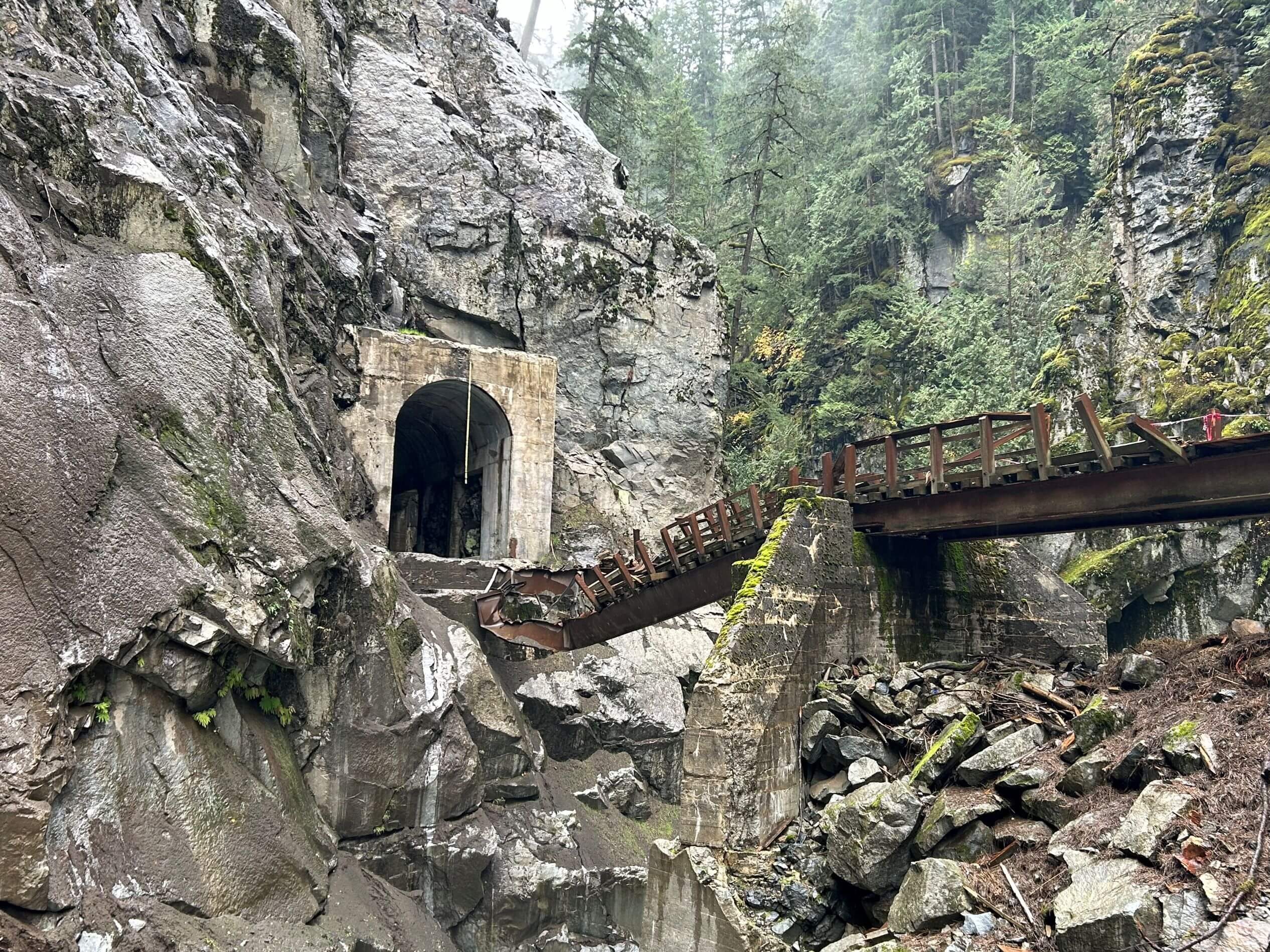
Following damage during the November 2021 Atmospheric River Event, structures within the canyon were assessed for public safety and resilience. Bridge 1 presented the highest structural risk and was closed immediately, along with the surrounding corridor.
Bridge 1 was originally a two-span pedestrian bridge supported on a central pier founded within an actively eroding canyon prone to frequent rockfall. Flood-driven erosion and material loss at the pier, combined with repeated rockfall impacts, undermined its stability and led to partial structural failure and loss of deck continuity. The bridge was deemed unsafe, severing the trail connection between the tunnel portals. Given the narrow canyon, exposed bedrock, and historic setting, a replacement structure eliminating in-channel supports was required. These constraints informed the decision to remove the centre pier and replace Bridge 1 with a single-span structure, eliminating the risk of future pier failure and stream blockage.
Approach
The design approach prioritized structural resilience, environmental protection, constructability within extreme site constraints, and preservation of the historic character of the Othello Tunnels corridor. Replacement of Bridge 1 required an integrated structural and geotechnical strategy addressing erosion, rockfall hazards, restricted access, and limits on in-water works.
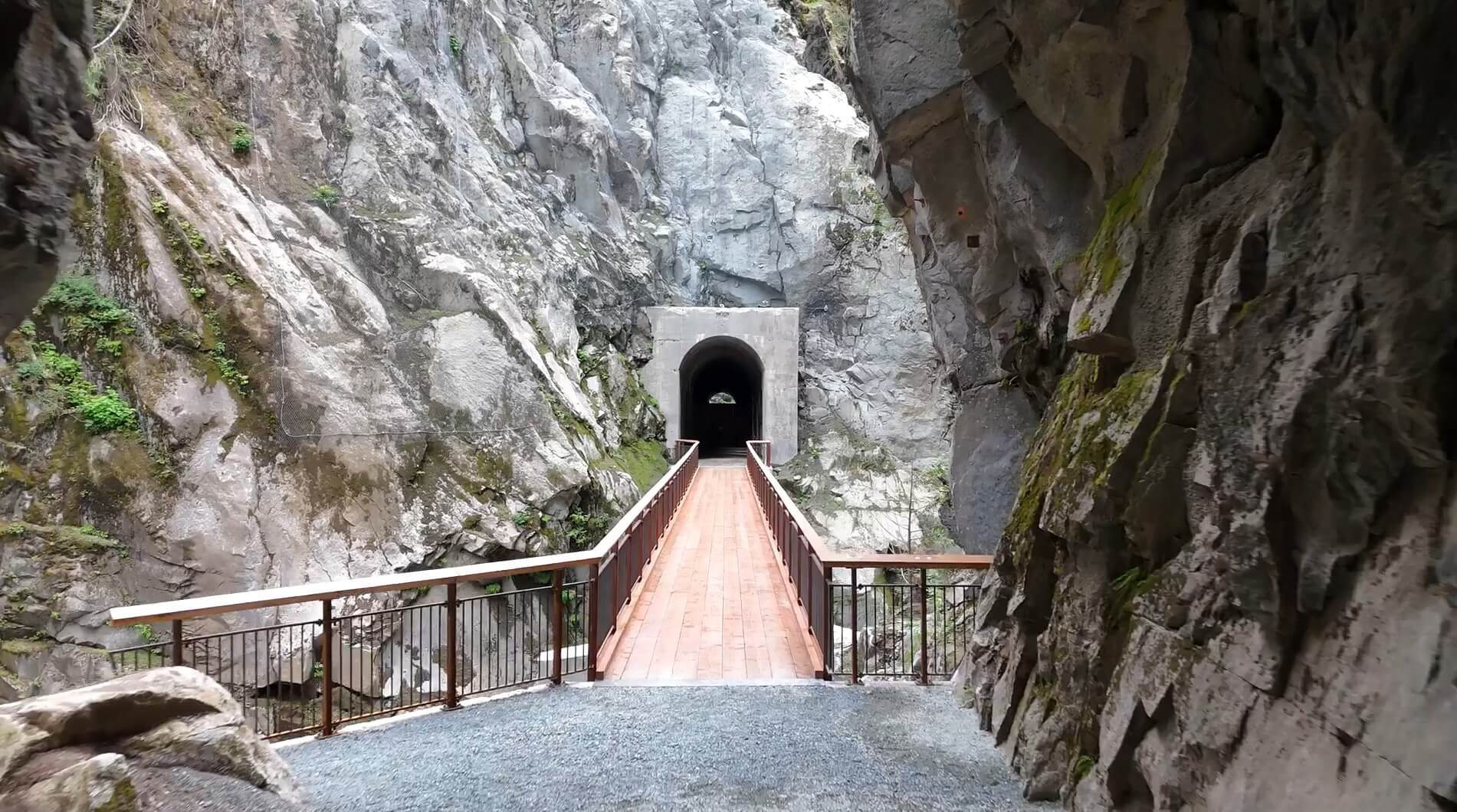
Multiple options were evaluated, including rehabilitation of the existing two-span bridge, replacement in kind, and removal of the centre pier. Options retaining an in-channel pier were rejected due to erosion, flood vulnerability, and river blockage risk. Modular systems were reviewed; however, their fixed geometry, required abutment modifications, and industrial appearance were incompatible with the historic setting. A custom clear-span solution supported on existing abutments was selected to address structural risk, heritage context, and constraints.
Environmental constraints governed construction methods and timing, including restrictions on in-water work within the Coquihalla River. These informed the decision to install the bridge using a staged longitudinal launch, avoiding in-channel works. Rockfall hazards were mitigated through targeted protection measures implemented prior to replacement to support safe construction and reduce long-term risk.
Western Red Cedar was selected for exposed timber elements, reflecting local traditions and cultural significance while providing durability.
Results
Bridge 1 was replaced with a 45 m clear-span crossing, eliminating the vulnerable centre pier and permanently removing in-channel erosion and rockfall risk. The solution restored continuous public access through the Othello Tunnels while avoiding in-water works and strengthening long-term climate resilience. At Bridge 2, full deck and railing replacement and targeted rockfall mitigation enhanced structural safety, durability, and user experience.
Service(s) Provided
- Structural condition assessments
- Options assessments and replacement strategy development
- Engineering design (structural and geotechnical)
- Construction and engineering support during construction
Project Team (Consultants)
COWI
Go back to projects in
View other projects from

Proudly presented by

Stay in touch with us
Subscribe to our mailing list!
Organization
Connect